
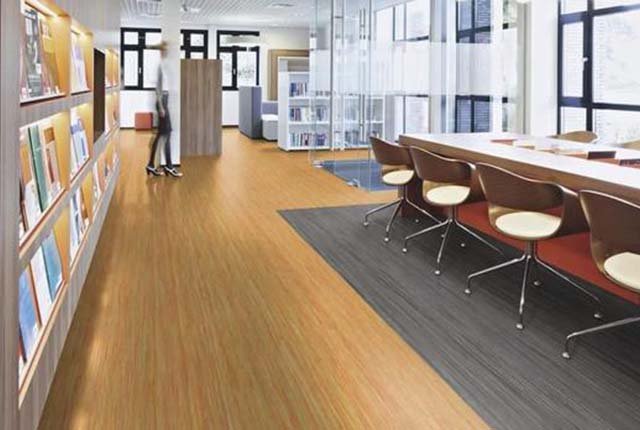
As a new type of environmentally friendly flooring material, the SPC flooring application has gradually expanded in recent years. Because they have many advantages:
- Zero formaldehyde
- Moisture-proof
- Fireproof
- Anti-slip
- High durability and other characteristics.
Therefore, it is widely used in developed countries such as Europe, America, and the Asia-Pacific market. Especially in public places such as shopping malls, office buildings, schools, and hotels, the usage rate of SPC floors is gradually increasing.
Today, we will analyze the current status and future development trends of the global and Chinese SPC flooring markets.
Global SPC Flooring Market Overview
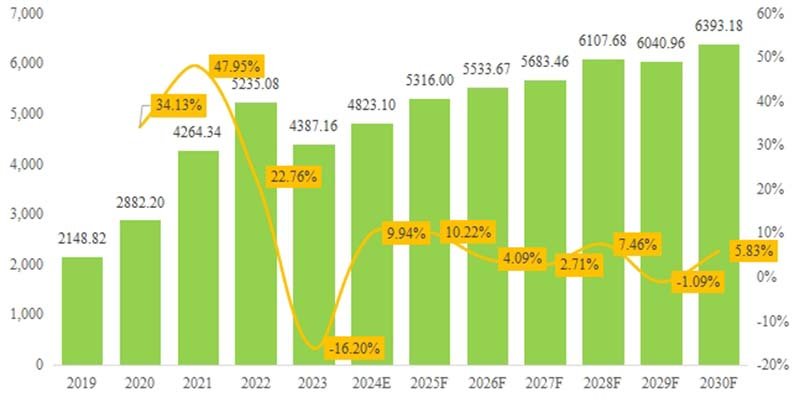
According to statistics in 2023, the global SPC flooring market size is about US$4.387 billion. It is expected to reach US$6.393 billion by 2030, with a compound annual growth rate (CAGR) of 4.81% between 2024 and 2030.
This growth is driven by three engines:
- Environmental policy promotion: The EU “Green New Deal” and the US LEED certification system accelerate the replacement of traditional floor materials
- Consumption upgrade demand: The middle class has a rising preference for durable and easy-to-maintain home products
- Technological innovation breakthrough: 3D printing texture technology achieves 98% simulation of wood grain/stone grain
Global demand changes
- From 2010 to 2021, the SPC flooring export market continued to grow, even the impact of the epidemic could not stop it.
- In 2022, the global economic downturn caused a decline in consumer market demand, and the growth rate of the SPC floor market slowed down.
- In 2023, SPC flooring is still in the penetration period in the Chinese market, but with the promotion of green building materials, China demand is growing rapidly.
Global division of labor and manufacturing transfer trends
US market:
In 2023, it accounted for 55.04% of the global SPC flooring market, and the CAGR is expected to be about 2.94% in the next six years.
Chinese market:
China is currently the world’s largest producer of SPC flooring. In 2023, it will account for 6.99% of the global market. It is expected that by 2030, the compound annual growth rate (CAGR) will reach 7.56%, and the market size will reach US$521.62 million.
Other markets:
The North American market accounts for 5.98%, the main countries in the European market include Germany, the United Kingdom, France, Italy and Russia, and the Asia-Pacific market includes Japan, South Korea and other countries, while the growth potential in the Middle East and Africa has yet to be developed.
Analysis of major SPC floor manufacturers
The global SPC floor market is dominated by Chinese and American SPC flooring manufacturers, among which the main manufacturers include:
- Zhejiang Tianzhen Technology Co., Ltd.
- Zhejiang Walrus New Materials Co., Ltd.
- Cai Nafuno Wood Industry
- Zhejiang Jingtong New Materials Group Co., Ltd.
- Mohawk Industries (Mohawk)
- Mannington Mills
- Decno Group
These manufacturers account for about 16.09% of the global market share. In particular, Chinese manufacturers dominate the production of SPC floors, and about 72.00% of the global market share comes from China.
However, The TOP5 Chinese companies represented by Cainafuno and Zhejiang Walrus contribute 16.09% of the global share, but 95% of their revenue depends on European and American orders. This “OEM model” makes the company’s risk resistance weak. For example, Zhejiang Tianzhen’s revenue dropped by 42% in 2023 due to customer loss.
Challenges of China’s SPC flooring industry
Uncertainty in the export market
In recent years, China’s exports of SPC flooring to the United States have declined due to the US’s imposition of tariffs on Chinese goods and the unstable international economic situation.
In the future, with the changes in Sino-US trade relations and the support of European and American markets for local production, Chinese SPC flooring companies may face greater challenges.
Intensified competition in the China market
Due to the traditional advantages of ceramic tiles and solid wood floors, SPC flooring still has a small market share in the domestic market.
However, with the improvement of environmental awareness, the demand for SPC flooring in public buildings such as shopping malls, hotels, and schools is growing.
Insights into the core trends of SPC flooring in 2025
Regional market reconstruction
- North American market: CAGR is expected to be 2.94% from 2024 to 2030, with the increase coming from residential renovation (accounting for 65% of demand)
- European market: After the Russian-Ukrainian conflict, the construction of local production capacity in Germany and Poland has accelerated. It is expected that the proportion of localized production will reach 30% in 2030
- Asia-Pacific market: Vietnam’s production capacity will exceed US$1 billion in 2023, and tariff advantages will attract Chinese companies to set up factories; emerging demand in India and Southeast Asia will increase by 12% annually
Product innovation direction
- Material revolution: The proportion of bio-based PVC will increase from 8% in 2023 to 15% in 2025
- Function upgrade: antibacterial coating (killing rate>99.9%), floor heating special type (temperature resistance 120℃) become mainstream configuration
- Design trend: Demand for ultra-thin (less than 4mm) products increased by 40%, and large-size (2m×0.3m) panels are favored by commercial spaces
- Channel change: The rise of B2B2C model
- Direct supply of projects: The proportion of developers’ centralized procurement jumped from 12% in 2020 to 28% in 2023
- Cross-border e-commerce: The sales volume of SPC flooring on the US Amazon platform increased by 55% year-on-year, forcing companies to establish overseas warehouse networks
- Design institute bundling: 70% of leading companies cooperate with architectural designers to establish material libraries
Challenges and opportunities faced by Chinese SPC manufacturers and wholesalers
Four major risk warnings
- Trade barrier escalation: If the United States imposes a 25% tariff on China, China’s SPC flooring export cost will increase by 18%
- Customer concentration is too high: The average contribution rate of the top three customers is 65%, and the loss of a single customer may trigger a chain reaction
- Raw material fluctuations: PVC prices will fluctuate by 40% in 2023, and stone powder supply will be affected by environmental protection restrictions
- Technology iteration risk: WPC flooring diverts 10% of the high-end market share
Three major incremental opportunities
- Emerging market outbreak: The demand for commercial projects in the Middle East (UAE, Saudi Arabia) has increased by 25% annually.
- Green building dividend: China’s “14th Five-Year Plan” requires that the proportion of green building materials used in new buildings exceed 70%
- Old house renovation wave: European and American buildings in the 1970s entered the renovation cycle, giving birth to a $20 billion renewal market
What are the winning strategies for SPC wholesalers?
Supply chain optimization:
- Diversified procurement: You can establish a dual supply chain of “main supply from China + backup from Vietnam”. Reduce the proportion of single-source procurement to below 50%
- Intelligent inventory management: Apply AI prediction system to increase inventory turnover rate to 8 times/year
- Logistics innovation: Lease shared warehousing within 30 miles of US ports to shorten delivery cycle to 7 days
Product portfolio upgrade: seize high value
Create star product matrix:
- Basic model: price-sensitive model ($2.5-3.5/㎡)
- Profit model: function-enhanced model (antibacterial/quiet, 30% premium)
- Image model: designer joint series (premium 80-120%)
- Certification system construction: must obtain international certifications such as FloorScore and GREENGUARD
- Market development: focus on potential tracks
Key areas:
- US Sunshine Belt (Florida, Texas): new home construction growth rate 8%
- China Yangtze River Delta: fine housing policy promotes 25% annual increase in project procurement
- Sub-sectors:
- Medical education: antibacterial floor procurement budget increased by 40%
- Long-term rental apartments: demand for modular fast installation solutions surges
Digital transformation: building a competitive moat
3D visual material selection:
You can develop an AR simulation system to allow customers to preview the paving effect on their mobile phones
Data middle platform construction:
You can integrate customs data, real estate start-up rate and other 20+ dimensions to establish a demand forecasting model
Private domain traffic operation
You can develop North American small and medium-sized contractors through LinkedIn, with a conversion rate of up to 15%
Future outlook: global landscape under reconstruction
By 2025, the SPC flooring market will present a “three-legged” pattern: China maintains its manufacturing advantage, Vietnam undertakes the transfer of low-end and medium-end production capacity, and localized production in Europe and the United States meets high-end customization needs. For wholesalers, the success factors are undergoing a fundamental change:
From price competition to value services
You can provide value-added services such as design support, logistics and finance
From passive procurement to ecological construction
You can form a community of interests with installers and designers
Shifting from regional operations to global configuration
You should establish multi-time zone and multi-currency operational capabilities
In this industry reshuffle, if you can do these jobs:
- Plan supply chain resilience in advance;
- Deeply cultivate segmented scenarios;
- Build digital capabilities etc;
As a wholesaler, you will be expected to take the lead in the $20 billion incremental market. As the CEO of Mohawk Industries said: “The winners of the future will not belong to the largest, but to the ones who can adapt to changes the most.”
Conclusion
The global SPC flooring market still has room for growth, but the growth rate has slowed down due to the impact of the global economy.
China dominates the production of SPC flooring and mainly relies on the export market. However, affected by international trade policies and the global economic environment, Chinese companies are gradually transferring part of their production capacity to other countries such as Vietnam. However, with the increasing rise of environmental protection, the penetration rate of the SPC flooring market has increased, and the demand for commercial spaces such as shopping malls, office buildings, and hotels has increased significantly.
In short, the SPC flooring industry is in a stage of change, with opportunities and challenges coexisting. SPC Flooring Companies should actively deploy global markets to meet the challenges and opportunities of the future market.